AI search has quietly become a trust exercise, and most businesses are failing it. A 2026 survey found that 96% of B2B companies are effectively invisible in AI discovery, and among domains that do get cited, only 30% stay visible from one AI answer to the next, with just 20% remaining present across five consecutive runs. Ahrefs’ correlation analysis across 75,000 brands found that brand mentions correlate far more strongly with AI Overview visibility than backlinks do, suggesting that being talked about carries more weight than being linked to. This shift puts E-E-A-T, Experience, Expertise, Authoritativeness, and Trustworthiness, at the center of a very different visibility game than traditional SEO ever required. This guide breaks down what that actually means in practice and how businesses can build the signals AI systems are increasingly relying on.
What E-E-A-T Actually Means for AI Search
Google originally introduced E-E-A-T as a framework for human quality raters evaluating search results, but its underlying logic has become directly relevant to how generative AI systems decide which sources to trust and cite.
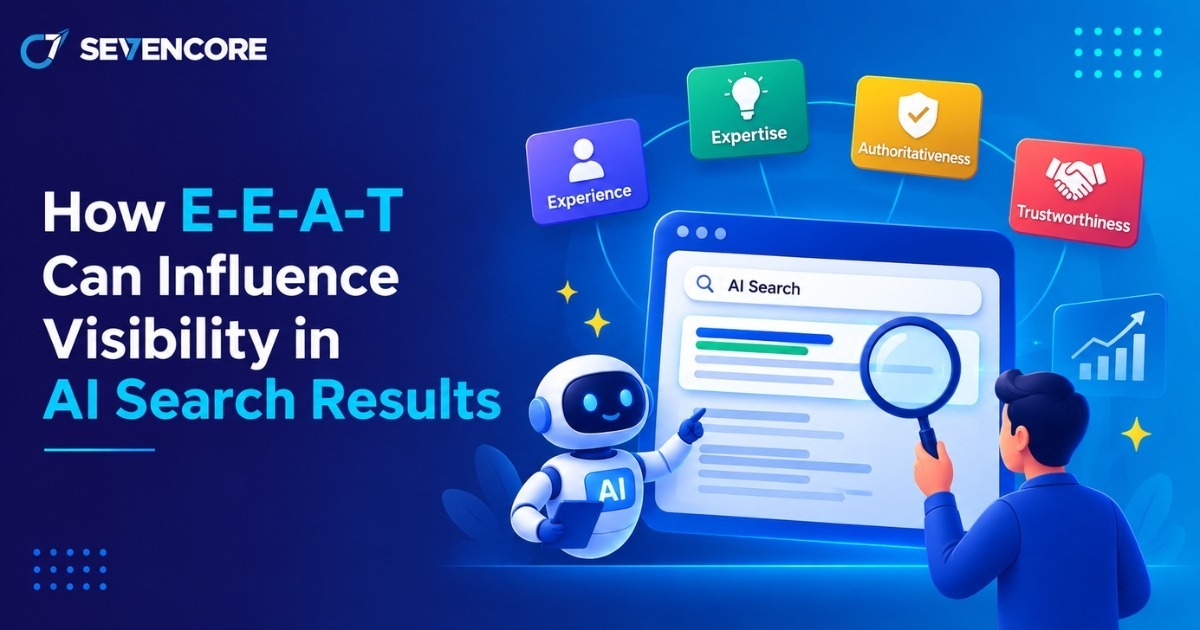
The Four Components in an AI Search Context
- Experience: First-hand, demonstrated involvement with a topic, which AI systems increasingly weigh when selecting sources for practical or how-to queries
- Expertise: Depth of subject knowledge, often signaled through detailed, technically accurate content rather than surface-level summaries
- Authoritativeness: Recognition from other credible sources and consistent presence across a subject area, not just a single well-optimized page
- Trustworthiness: Accuracy, transparency, and consistency, which matters enormously given how much AI-generated content still requires fact verification
Why AI Systems Reward Trust Signals More Than Keywords
Traditional SEO could often be won through keyword optimization and backlink volume alone. AI-driven search behaves differently, since generative systems are synthesizing an answer rather than simply ranking a list of links, which raises the bar for what counts as a reliable source.
- Content with concrete statistics has been shown to improve visibility in AI answers by as much as 22% in controlled testing
- Adding direct quotations to content improved AI answer visibility by up to 41% in the same body of research
- Citing external sources within content boosted visibility by 27% on average, rising to 115% for pages already ranked lower among retrieved sources
The Trust Gap Most Businesses Don’t Know They Have
Many businesses assume that ranking well in traditional search automatically translates to AI visibility, but the data shows a persistent and measurable gap between the two.
- Across 680 million tracked citations, only 11% of domains were cited by both ChatGPT and Perplexity, meaning strong performance in one AI engine says little about performance in another
- Brand citation rates vary by as much as 46 times across different AI engines, with ChatGPT citing brands far less frequently than Perplexity in comparable testing
- Fewer than one in five brands achieve both frequent mentions and consistent citations across AI answers, a pattern researchers have called the “Mention-Source Divide”
Building Genuine Experience Signals
AI systems increasingly favor content that demonstrates real, first-hand involvement rather than generic, aggregated information that could have been written by anyone about anything.
- Publish original case studies, data, or findings rather than summarizing what competitors have already published
- Include specific, verifiable details, names, numbers, dates, that generic content typically omits
- Show the actual process behind a claim rather than only stating the conclusion, since AI systems favor content that demonstrates how a result was reached
Strengthening Expertise Through Content Depth
Surface-level content increasingly struggles to compete for AI citation, since generative systems can already produce shallow summaries themselves and instead seek sources that go further.
- Cover a topic thoroughly enough that a reader would not need to search elsewhere for the core answer
- Use precise, accurate terminology rather than vague, generalized language that signals limited subject familiarity
- Update older content regularly, since AI systems increasingly favor current, well-maintained information over static, aging pages
Also Read: How to Choose the Right Odoo Modules for Your Business
Authoritativeness Now Means Multi-Surface Presence
A single well-optimized page rarely builds the kind of authority AI systems reward. Genuine authority increasingly comes from consistent presence across a subject area, not concentrated effort on one asset.
- Publish consistently within a defined subject area rather than scattering content across unrelated topics
- Build recognition through mentions on other credible sites, since brand mentions correlate more strongly with AI Overview visibility than raw backlink counts
- Maintain consistent messaging and positioning across a website, social presence, and any third-party coverage, since fragmented signals dilute authority
Trustworthiness in an Environment Full of AI-Generated Noise
As more content online is itself AI-generated, human-verified accuracy and transparency have become more valuable, not less, as a differentiator.
- Clearly attribute data and claims to named, verifiable sources rather than vague references
- Correct outdated or inaccurate information promptly, since AI systems that detect inconsistency across a site’s content may deprioritize it as a source
- Disclose authorship and relevant credentials where appropriate, particularly for topics where accuracy carries real consequences, such as health, finance, or legal content
How This Connects to Broader SEO and Marketing Strategy
E-E-A-T does not operate in isolation from the rest of a business’s digital marketing strategy. Reviewing how AI is reshaping the broader SEO landscape helps clarify why trust signals now matter as much as technical optimization, since the two increasingly work together rather than as separate disciplines.
- Local and service-based businesses benefit from consistent, verifiable location and service information across every platform where they appear
- Content strategy should prioritize depth and accuracy over volume, since a smaller number of authoritative pieces often outperforms a larger volume of thin content
- Paid channels like PPC services can drive traffic in the short term, but they do not substitute for the organic trust signals that influence long-term AI visibility
Measuring Whether E-E-A-T Efforts Are Actually Working
Traditional ranking reports do not capture AI citation behavior, which means businesses need a different set of metrics to understand whether their trust-building efforts are paying off.
- Track how often your brand or content is mentioned across AI-generated answers for relevant queries, not just traditional search rankings
- Monitor citation consistency over multiple queries and time periods, since a single appearance in an AI answer does not indicate durable visibility
- Compare visibility across different AI engines separately, since strong performance in one does not predict performance in others
Frequently Asked Questions
Does E-E-A-T directly affect AI search rankings the way it affects Google rankings?
Not in an identical, measurable way, since AI systems use their own retrieval and citation logic. However, the underlying signals E-E-A-T represents, demonstrated experience, subject depth, external recognition, and verifiable accuracy, closely align with what generative AI systems favor when selecting sources to cite.
Can a small business realistically compete for AI search visibility against larger competitors?
Yes, particularly in specific, well-defined niches. AI systems favor depth and genuine authority over sheer content volume, which gives smaller, focused businesses a real opportunity to be cited ahead of larger competitors publishing broader but shallower content.
How long does it take to see results from focusing on E-E-A-T signals?
There is no fixed timeline, but since AI citation behavior often shifts as underlying training and retrieval data updates, consistent effort over several months typically shows more durable results than a short-term content push.
What This Means Going Forward
As AI Overviews and generative answer engines continue capturing a larger share of search behavior, the businesses building genuine authority now are positioned to benefit disproportionately later, since AI systems tend to reinforce sources that already demonstrate consistent trustworthiness. Waiting until AI search visibility becomes an urgent, obvious problem means competing from behind against businesses that have already built the trust signals AI systems are learning to rely on.
Conclusion
E-E-A-T has moved from a quality guideline for human search raters to a practical framework for winning visibility in a search landscape increasingly shaped by generative AI. Businesses that demonstrate real experience, build genuine subject depth, earn recognition across multiple credible sources, and maintain consistent, verifiable accuracy are the ones AI systems are learning to trust and cite. The gap between visible and invisible brands in AI search is already wide, and it is set to grow wider as these systems continue refining how they decide who to quote and recommend.