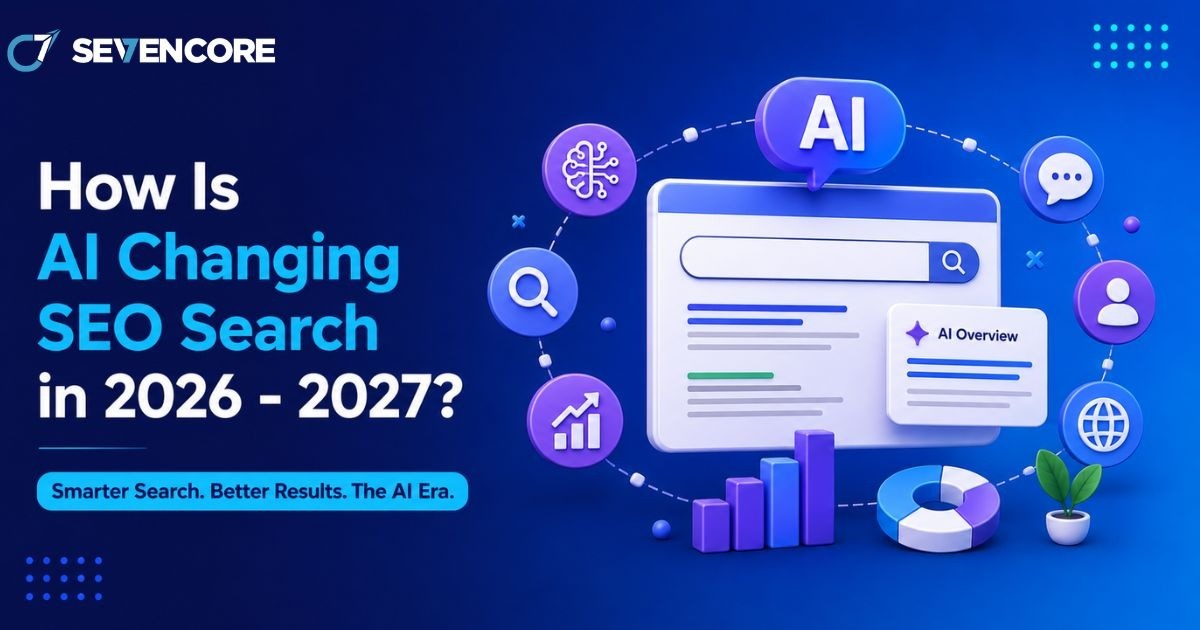
Search isn’t just a process of entering a query and getting a list of links anymore. Google AI Overviews, AI Mode, ChatGPT, and others are reshaping the way people go about discovering information, comparing alternatives and determining what sources to trust. With so many synthetic answers processed by AI, users no longer have to visit several websites to obtain the answer they are looking for.
How is AI changing SEO in 2026? AI is transforming SEO from page ranking and click generation to more of an understanding, trust, citation and recommendation approach to search systems. While traditional rankings are still relevant, brands must also make sure that the content they have is easily accessible for AI to quickly extract, verify and utilize for answers. The visibility of search results and AI-driven answers are becoming more crucial, with citations, brand mentions, AI referral traffic, and assisted conversions now more significant than clicks and rankings.
What Is AI Search, and How Is It Different From Traditional SEO?
AI search is a type of search that leverages AI to better understand a user’s query, fetch relevant information, and create a synthesized answer as opposed to just ranking a list of web pages.
SEO vs AEO vs GEO — Comparison Table
| Aspect | SEO | AEO | GEO |
| Full Form | Search Engine Optimization | Answer Engine Optimization | Generative Engine Optimization |
| What It Does | When it comes to improving a webpage’s visibility and ranking in the traditional search engine results, it is the SEO expert who can help. | Restructures coding for content that will allow search and answer engines to give direct answers to users’ queries. | Investigates ways to improve the likelihood of the brand or source being cited, included or recommended in the answers generated by AI. |
| Primary Purpose | Be seen more and get organic clicks. | To be the answer to a query by a user. | To join the answer generated by AI. |
| Focus Areas | Focuses on keywords, crawlability, backlinks, technical SEO and page relevance. | Focuses on short answers, FAQs, chunked content and question keywords. | Focuses on the extractability and verifiability of elements, contextual clarity, entity authority and brand signals. |
| How to Measure | Rankings and traffic from organic search. | Answer inclusion, answer visibility. | AI citations, share of model/brand mentions, AI referral traffic. |
All three disciplines are complementary and not mutually exclusive. While AI is reshaping SEO, it is clear that traditional techniques will not be completely replaced by AI algorithms.Though AI is transforming SEO, it is essential to remember that traditional SEO has its own role and can’t be fully replaced by AI algorithms. In the past, businesses had to optimize for the information being located after the URL, but now things are different.
How Much Search Has Already Shifted to AI
The behavioural change is becoming reality. From 2025 to 2026, AI-powered discovery is increasingly a factor in the search experience, with multiple datasets revealing that it is already a major driver of the search landscape, especially for research-oriented and conversational queries.
AI Search by the Numbers
- Data from Salt Creative in June 2026 indicates that Google’s AI Overviews have a reach of over 2 billion users monthly in over 200 countries. In addition, ChatGPT has become the world’s most popular weekly active user with over 700 million. (sltcreative.com)
- The 93% zero-click rate in AI Mode is based on industry analysis data from Digital Applied 2026, which indicate that about 93% of the visits to Google AI Mode are not to external websites. (Digital Applied)
- More detailed and conversational user questions, 3× longer queries: Google reported that users asking questions in AI Mode are asking about 3 times the number of words, which is indicative of more detailed and conversational user queries. (Q4 Capital)
- According to Gen Z: Semrush, in November 2025, almost 35% of the Gen Z users in the USA used AI chatbots to look for information. (Semrush)
- 58.5% zero-click: Goodfirms notes 58.5% of all Google searches are zero-click, and only 14% of marketers now track the visibility of citations from AI/ LLMs. (Goodfirms)
- 43% are using AI optimization: 43% of marketers are actively using AI and LLM optimization; SEO is one of the fastest growing strategic areas of marketing. (Goodfirms)
The numbers illustrate an important difference. AI isn’t just taking the place of search. It’s growing the search engine ecosystem.
From Rankings to Citations
For years, the focus of SEO reporting was on these questions: What’s our rank? How many people visited our website? How many visitors did we attract to our website? Was there a decrease or increase in our organic CTR? The questions haven’t gone away but they don’t fully explain it anymore.
Over the years, companies have been making increasing efforts to track:
- Number of citations / references to the brand: How many times is the brand cited or mentioned in an AI system?
- Model share: What percentage of the brand is being used in comparison to the other brands when it comes to pertinent prompts?
- AI referral traffic: What is the amount of traffic coming from AI platforms?
- Assisted conversions: How many times does AI visibility help to trigger a conversion?
What’s crucial is not to give up on rankings. It’s to get rid of thinking about ranking as the sole measure of success.
From Keywords to Entities and Intent
Look at the difference between “CRM software” vs. “What CRM software is best for a 50-person B2B sales team that wants to be integrated with Salesforce, have automated reporting, and be implemented in a matter of months?”
While the use of keywords still works, it’s now more difficult to distill information down to just a single word or phrase for a user with AI search. The second question has both intent and context, constraints and multiple related entities. AI search is designed to handle that more contextual information.
From Content Volume to Content Verifiability
It is easier to create content with Generative AI. Which means more content is less of a competitive edge. The difference of quality over quantity lies whether the information is useful, accurate, attributable and verifiable.
That means:
- Use clear headings which state what is to follow.
- Give the answers to significant questions.
- Give credit to specific sources and/or individuals.
- Provide evidence to back up facts and opinions.
- Where appropriate use structured data.
- Ensure product, service, pricing and technical information is up-to-date.
- Ensure that there is sufficient context to avoid people taking the words out of context.
It’s not just about reading content; it’s about reading content in a way that is easily accessible. Its purpose is to access the content and to ensure its trustworthiness.
From Link Building to Brand and Entity Authority
The days where backlinks were everything, are things of the past. However, the power of AI search is not limited to just link equity. AI systems might come into contact with brand information through various channels like websites, communities, video platforms, reference materials, reviews, publications, and other digital spaces. A larger web presence can contribute to the brand identity, its activities and its reputation.
This means a wider spread of the power structure:
| Traditional Authority Model | AI-Era Authority Model |
| Backlinks | Backlinks + brand mentions |
| Domain authority | Entity authority |
| Page relevance | Relationships between topics and entities |
| Keyword relevance | Contextual relevance |
| Website content | Website + third-party ecosystem |
| Ranking signals | Ranking + citation signals |
| Link acquisition | Reputation and corroboration |
Community and reference sites can, therefore, be important in addition to the company’s own site. The goal is to create brand awareness and ensure the brand is always portrayed in the same fashion in the information ecosystem that AI systems use to create answers.
Also Read: Local SEO Strategies to Grow Your Service Business in India
What This Means for CTR and Traffic
If users get the answer from AI, why would they click? Such a concern is quite natural. This doesn’t imply that all web pages will lose the same amount of traffic. This impact depends on the type of query, search intent, industry, the composition of the SERPs, and the presence of an AI-generated answer.
But it is clear that the strategy to just optimize for clicks is not enough. You can brand yourself, position yourself, share your know-how with your user and trigger an opinion without ever visiting your website. This also means that SEO dashboards should change.
A More Complete SEO KPI Framework
Rather than just report:
- Rankings
- Organic sessions
- CTR
- Pageviews
- Conversions
These should be further supplemented with teams being increasingly able to integrate the following:
- AI citation frequency
- The share that is given in the citations, compared to the competition.
- AI answer inclusion
- Brand mention frequency
- AI referral traffic
- Assisted conversions
- Prompt-level visibility
- The accuracy of the brand data created using AI
The goal is not to “replace” the old dashboard with an AI dashboard.
New SEO Priorities for 2026
Hybrid SEO tactics are the best ones to use. They maintain traditional search techniques and incorporate additional layers tailored for AI retrieval and synthesis.
1. Structure Content for Extractability
Utilize descriptive H-tags, paragraphs answering the question, concise definitions, comparison tables, lists, FAQs, and logical information architecture. The content must be comprehensible even if only a part is pulled out of the rest of the page.
2. Build Topical and Entity Authority
Avoid having too many separate pages based on different keyword permutations. Create a significant amount of information about the entities, questions, use cases, problems and decisions that make up your market.
3. Invest in AI and LLM Optimization
43% of the surveyed marketers were already using AI/LLM optimization techniques in 2026, according to the Goodfirms study. That makes the GEO and AEO more and more popular than experimental.
4. Track AI-Specific Metrics
If a company is not able to track how their brand is showing up in the answers generated by AI, they won’t be able to accurately assess if they are successfully implementing their AI search approach. Only 14% of marketers currently are able to measure the visibility of AI/LLM citations, as found by GoodFirms.
5. Maintain Traditional Technical SEO
There’s no need to sacrifice crawlability, indexability, internal linking, page performance, mobile usability, structured data or any other technical details when optimizing for AI. While AI-driven search can handle a lot of queries, traditional SEO remains relevant for those that don’t rely on it. Also, traditional search can be an effective starting point for AI search systems to find and understand content.
Common Mistakes Brands Are Making in 2026
The worst mistakes are not necessarily due to the lack of awareness. Many marketing teams realize that AI search is revolutionizing discovery. A lot of marketing teams are aware that AI search is transforming the way discovery happens. The bigger challenge is understanding measurable infrastructure.
Mistake 1: Assuming Rankings Tell the Whole Story
A page can rank well organically and also not even be included in the user-generated answer that is produced by the AI. While ranking is still valuable, it doesn’t offer the same level of insight into AI visibility.
Mistake 2: Ignoring AI Visibility Tracking
When asked about their efforts on AI optimization, 43% of marketers at Goodfirms said it’s a strategy they’re currently working on, with only 14% tracking visibility of AI/LLM citations. This means that there is a clear gap in measurements. Teams are putting money into this new channel of visibility, but do not measure and report on whether they are visible there.
Mistake 3: Treating GEO as an Add-on
It is not a true AI search strategy, even if a couple of FAQs are added or some of the headings are changed. GEO impacts on content architecture, entity clarity, authority, structured information, brand reputation, measurement and governance. It must be considered a component of the digital infrastructure and not an add-on, as if it is a content optimisation layer meant for last minute.
Mistake 4: Publishing AI Content Without Strong Editorial Controls
While AI can significantly speed up the process of creating content, it can also result in generic claims, outdated content, inaccuracies, and first-hand expertise content. This is especially hazardous when the end goal is to be referred to by AI systems. If the source is not trustworthy, it won’t be beneficial to be highly visible in AI answers.
Mistake 5: Optimizing for Keywords While Ignoring Questions
The longer query is in AI Mode, the more granular a user needs are, with longer queries. A web page with one particular key word and a text that provides no answers to the web page questions may not be as useful as a page that covers the problem a user is trying to solve. The new search isn’t about repeating a phrase, rather it is about answering a need.
SEO in 2026 Is Becoming a Visibility Discipline
A business can appear in a search and not be included in the AI-generated output. It can get less clicks and have a greater impact on more decisions. It can generate hundreds of pages, and will be hard for AI systems to comprehend. On the other hand, a brand that clearly provides information, authority, content structure and a clear presence of the brand value can be the solution before the potential customer ever visits the brand’s website.Today the question isn’t “where do we rank?” It is “when someone asks an AI system about our category, problem, product or expertise, are we part of the answer and is the information about us correct?” There is this whole paradigm shift happening when the question is asked like this. The content should be organized for extracting, the claims should be substantiable, the expertise should be explicit, the entities should be clearly distinguishable and the performance should be evaluated in both non- and AI-based search.