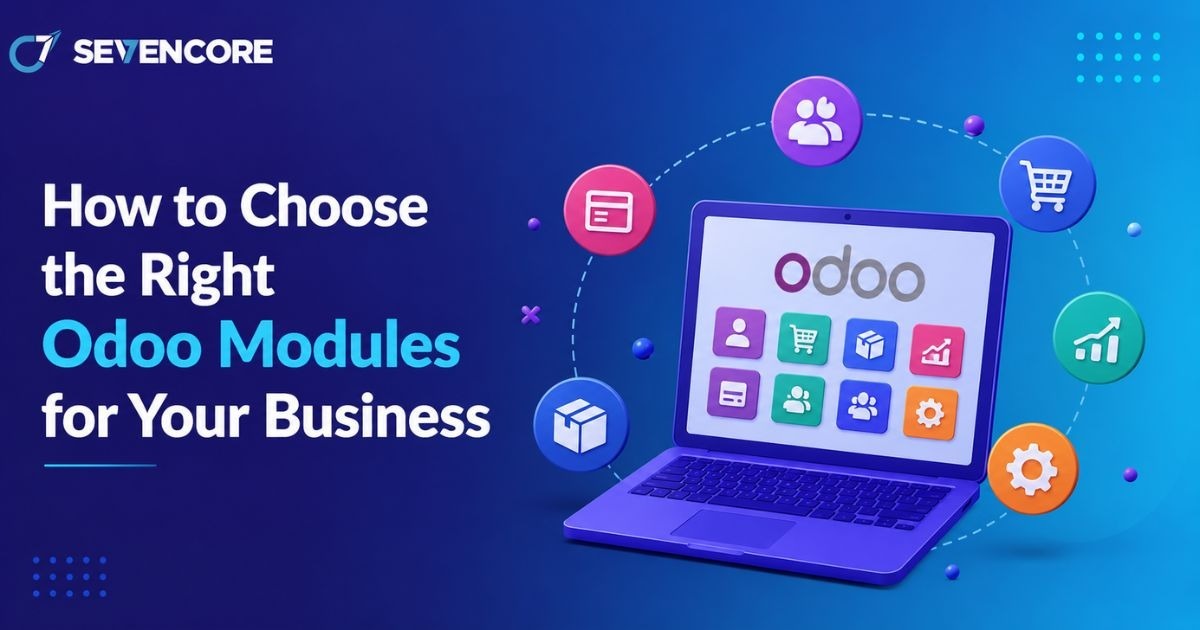
Odoo’s biggest strength, its modular design, is also where most businesses go wrong. Odoo now holds a 5.77% share of the global ERP market and 12 to 15% of the SME ERP segment specifically, with over 16 million users worldwide and roughly 120,000 new customers added every year. Yet ERP failure risk remains real even on a flexible platform like Odoo, with 75% of ERP projects missing their objectives and 74% exceeding budget, most often due to poor scoping rather than the software itself. Choosing modules based on what looks impressive in a demo, rather than what the business actually needs right now, is one of the fastest ways to end up in that failure statistic. This guide breaks down a practical framework for selecting the right Odoo modules for your business stage, without overbuilding or underdelivering.
Why Module Selection Is the Most Important Early Decision
Odoo’s modular architecture is a major advantage precisely because businesses can start small and expand later, but that advantage only pays off if the initial module selection matches actual operational needs rather than a wish list.
What Happens When Module Selection Goes Wrong
- Paying for and maintaining modules that sit unused, adding complexity without real value
- Missing a core module early on, then bolting it on later with messy data migration
- Overcomplicating workflows for teams not yet ready for advanced automation
- Losing the cost advantage that makes Odoo attractive in the first place, since unnecessary modules add configuration and support overhead
Start With Core Operational Modules
Most successful Odoo implementations begin with a small, focused set of modules rather than a full suite rollout on day one.
The Modules Most Businesses Should Start With
- Accounting: Almost universally considered the most critical starting module, since financial visibility underpins every other business decision
- Sales and CRM: Forms the foundation for tracking leads, quotes, and customer relationships from day one
- Inventory Management: Essential for any business handling physical goods, providing real-time stock visibility
- Most SMEs should start with three to five core modules and expand as the business grows, rather than deploying the full suite immediately
Match Modules to Your Industry
Beyond the core operational modules, the right additions depend heavily on what kind of business you actually run.
- Manufacturing businesses benefit most from adding Manufacturing (MRP) and Quality modules early, since production tracking and lead-time visibility drive measurable ROI, with reported reductions of 25 to 35% in production lead times
- Retail and eCommerce businesses should prioritize Website and eCommerce modules alongside Inventory, since Odoo’s fully integrated online store solution supports omnichannel sales without a separate platform
- Service-based businesses typically get more value from Project Management and Timesheets than from manufacturing-focused modules
- Hospitality and real estate businesses have reported 40 to 60% faster setup times when modules are chosen specifically around booking, scheduling, or property workflows rather than generic templates
Evaluate Modules Against Real Operational Gaps
Rather than browsing the Odoo app marketplace and picking modules that sound useful, the more reliable approach starts with mapping actual pain points first.
- List the specific manual processes currently consuming the most staff time
- Identify where data currently lives in disconnected spreadsheets or separate tools
- Prioritize modules that directly replace a known inefficiency over ones that add speculative future capability
- Avoid selecting a module simply because a competitor uses it, since operational needs vary significantly even within the same industry
Also Read: 5 Signs Your Website Urgently Needs a Redesign
Consider a Phased Implementation Approach
A phased rollout consistently outperforms an all-at-once deployment, both in terms of cost control and user adoption.
- Implementation timelines for 10 to 25 users typically run two to four months, compared to six to twelve months for larger deployments with 100 or more users
- Starting with core financial and sales modules lets a team stabilize on the new system before layering in more complex automation
- Firms working with a certified Odoo partner see implementation processes roughly 40% faster than those attempting rollout without proper gap analysis beforehand
- Adding modules incrementally also spreads training and change management effort across a longer period, reducing disruption to daily operations
When Custom Development Fits Into Module Selection
Standard modules cover a wide range of business needs, but not every workflow fits neatly into an out-of-the-box configuration. This is where Odoo custom development becomes relevant, extending or adapting existing modules to match specific business logic rather than forcing a workaround inside a module that was not designed for it.
- Custom development should follow, not replace, a careful evaluation of what standard modules can already handle
- Over-customizing early, before understanding how the standard modules perform in daily use, often creates unnecessary long-term maintenance overhead
- The strongest implementations reserve custom development for genuine gaps, not convenience preferences that a minor process change could solve instead
Avoiding Common Module Selection Mistakes
Even businesses that understand Odoo’s modular structure in theory often make avoidable mistakes in practice.
- Selecting every available module upfront instead of starting with a focused core set
- Skipping a proper gap analysis before committing to a module list, which frequently leads to mismatched configurations
- Underestimating the training and change management required even for modules that seem intuitive
- Ignoring how modules will integrate with each other, since Odoo’s native integration only delivers its full value when workflows are mapped correctly across departments
Getting the Right Support for Odoo Erp Development
Selecting modules correctly the first time depends heavily on who is guiding the process. Businesses approaching a full Odoo ERP development project benefit significantly from a structured discovery phase that maps existing workflows before any module gets activated, rather than configuring software first and adjusting processes afterward.
- A proper gap analysis before development begins is one of the clearest predictors of project success
- Teams that skip this step frequently discover mismatches between the chosen modules and actual business requirements only after go-live
- Ongoing support after initial deployment, including configuration tweaks and new module additions as the business grows, should be planned as part of the relationship from the start, not treated as a separate emergency later
Frequently Asked Questions
How many Odoo modules should a small business start with?
Most SMEs should begin with three to five core modules, typically Accounting, Sales, CRM, and Inventory where applicable, then expand based on actual usage patterns rather than deploying the full suite immediately.
Can Odoo modules be added later without disrupting existing operations?
Yes. Odoo’s modular architecture is specifically designed to support incremental expansion, and adding modules later is one of its core advantages over legacy ERP systems that typically require a full reimplementation for new functionality.
Is it better to start with fewer modules or the full suite at once?
A phased approach starting with fewer, core modules consistently outperforms a full-suite rollout, since it allows teams to stabilize on the new system, build internal expertise, and avoid the higher failure risk associated with overly complex initial deployments.
Choosing the Right Odoo Development Company
Module selection is rarely a decision a business should make entirely alone, particularly for a first implementation. Working with the best Odoo development company for your specific industry and scale can shorten the evaluation process considerably, since experienced partners have already seen which module combinations work well for similar businesses and which ones consistently create friction.
- Ask any potential partner how they handle gap analysis before recommending specific modules
- Confirm whether they have direct experience in your industry, since manufacturing, retail, and service businesses have meaningfully different module priorities
- Look for partners who recommend a phased rollout rather than pushing the largest possible initial scope
Conclusion
Choosing the right Odoo modules comes down to matching software to actual operational needs, not deploying everything available on day one. Starting with a focused core, whether that is Accounting, Sales, CRM, or Inventory depending on the business, and expanding through a phased rollout consistently produces better outcomes than an ambitious all-at-once implementation. Businesses that pair careful module selection with a proper gap analysis, and bring in experienced support where needed, are the ones most likely to see Odoo’s modular design work in their favor rather than becoming another statistic in the industry’s persistently high ERP failure rate.