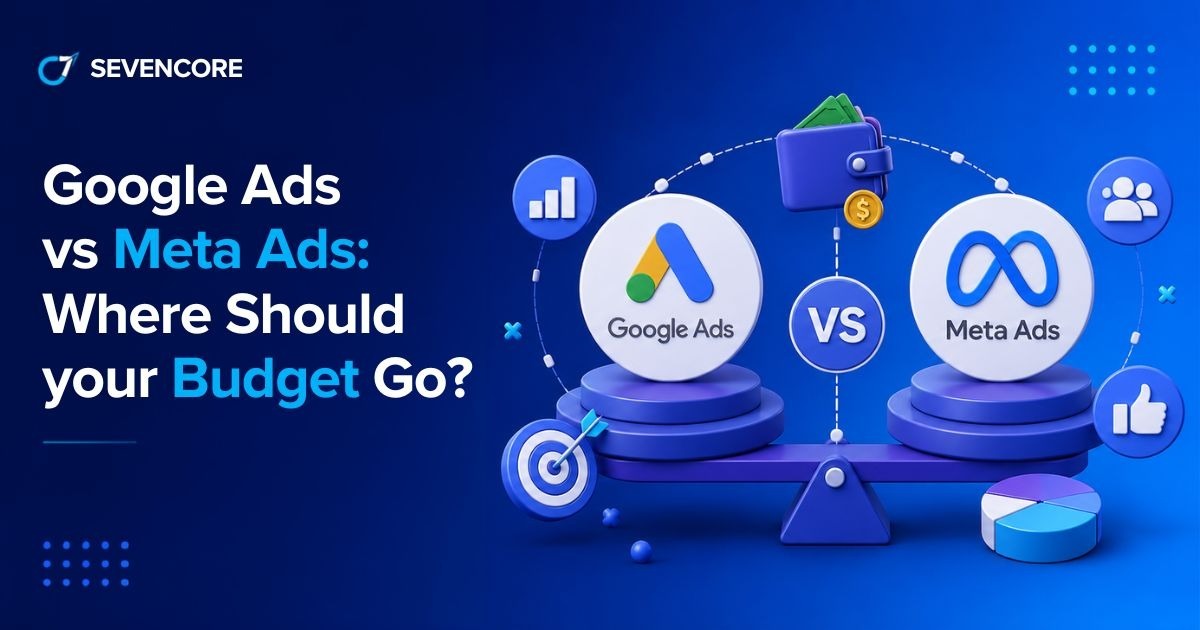
Every marketing team eventually faces the same question: should the next rupee, dollar, or euro of ad spend go toward search or social? The stakes are higher than ever. Worldwide digital ad spending crossed $750 billion in 2025, marking the first time it exceeded 75% of total media spend. For years, one platform sat comfortably ahead of the other, but that gap has nearly disappeared. Forecasts for 2026 show Meta pulling in roughly $243.46 billion in global ad revenue against Google’s $239.54 billion, giving Meta a 26.8% share of worldwide ad spend compared to Google’s 26.4%. Together with Amazon, these three platforms now account for over 62% of global digital advertising, leaving less room for guesswork in how a budget gets split. So the real question isn’t which platform is “winning” a market share race. It’s which one fits your business model, your funnel stage, and your customers’ buying behavior.
Understanding How Each Platform Works
Before splitting a budget, it helps to understand what each system was actually built to do.
How Google Ads Captures Demand
Google Ads is built around intent. When someone searches “best running shoes for flat feet” or “emergency plumber near me,” they are already looking for a solution. The platform serves ads based on that expressed need, using keywords, search terms, and buyer signals that already exist. This makes it a strong fit for:
- Businesses with a clear, searchable product or service
- Local service providers who rely on immediate demand
- E-commerce brands running Shopping campaigns and Performance Max
- Companies with longer sales cycles where research happens before purchase
Because the person is already searching, conversion rates on well-optimized campaigns tend to be strong, though competitive keywords can push cost per click higher in crowded industries.
How Meta Ads Builds Demand
Meta Ads, spanning Facebook and Instagram, works differently. Instead of waiting for someone to search, it places ads in front of people based on interests, behaviors, demographics, and lookalike audiences. This is demand generation rather than demand capture. It suits:
- Brands introducing a new product category
- Visually driven businesses like fashion, home goods, and beauty
- Impulse purchases and lower-cost items
- Retargeting campaigns aimed at website visitors or cart abandoners
Meta’s automated tools, particularly its Advantage+ suite, have become a major growth driver by using machine learning to handle audience targeting and creative optimization with fewer manual adjustments from the advertiser.
Comparing Cost, Reach, and Targeting
Budget decisions usually come down to three practical factors: what you pay, who you reach, and how precisely you can aim.
Cost Per Click and Cost Per Result
Search advertising costs vary enormously by industry. Legal, insurance, and finance keywords can run into double digits per click, while niche B2B terms may be far cheaper. Social advertising costs are typically lower per click but often require more volume to reach a buying decision, since the audience wasn’t actively searching in the first place.
Audience Reach
Google commands close to 90% of global search traffic, giving advertisers access to nearly every person actively looking for something online. Social platforms reach people during browsing, not searching, which means exposure happens earlier in the decision journey. Neither approach is inherently better; they simply intercept the customer at different moments.
Targeting Precision
- Search platforms target based on explicit queries and keyword intent
- Social platforms target based on interests, behaviors, and audience overlap
- Retargeting works on both, but tends to convert especially well on social feeds where visual reminders are effective
- First-party data integration is becoming increasingly important on both platforms as privacy rules tighten
Which Platform Fits Your Funnel Stage
A budget split that ignores funnel stage usually underperforms, regardless of platform quality.
Top of Funnel: Awareness
If your product or category needs explaining before anyone would think to search for it, social advertising generally does more work here. It introduces the brand through video, carousel, and image formats designed to stop the scroll rather than answer a query.
Middle of Funnel: Consideration
This is where the lines blur. Search ads capture people who have started researching and comparing options, while social ads can nurture interest through case studies, testimonials, and retargeting sequences aimed at people who already engaged with the brand.
Bottom of Funnel: Conversion
Search advertising tends to shine here because it meets people at the exact moment of purchase intent. Someone searching a specific product name or “buy now” phrase is close to a decision. Retargeting campaigns on social platforms also perform well at this stage, since they reach people who already showed interest but didn’t convert the first time.
Building a Budget Allocation Strategy
Rather than treating this as an either-or decision, most successful advertisers run both channels with deliberate weighting based on business goals.
- New or unfamiliar products: weight budget more heavily toward social platforms to build awareness before expecting search volume to exist
- Established products with clear demand: weight budget toward search, since people are already looking for what you sell
- Local service businesses: search usually delivers the strongest direct return, with social used mainly for brand trust and reviews
- E-commerce with visual appeal: a near-even split often works, using social for discovery and search for purchase completion
- Limited budgets: start with one platform, measure cost per acquisition over a full sales cycle, then expand into the second channel once a baseline exists
Testing in small increments, tracking cost per acquisition rather than cost per click alone, and revisiting the split every quarter tends to produce better results than locking in a fixed ratio and leaving it unchanged.
Final Thoughts
There isn’t a universal answer to where ad budget should go, and the market itself reflects that uncertainty. With Meta and Google now running nearly neck and neck in global ad revenue share, the old assumption that search automatically deserves the bigger slice no longer holds. The better approach is to match platform strengths to your specific funnel stage, product type, and customer behavior, then let performance data guide future adjustments rather than industry headlines or last year’s budget template.
Sources for Citation
- eMarketer / Marketing Dive — “Meta to shoot past Google in digital ad revenue for first time” (2026 forecast data on ad revenue and market share)
- Adweek — “Meta Is Quietly Becoming a Bigger Ad Business Than Google” (2026)
- StatCounter — Global search engine market share statistics (2026)
- MediaPost — “Meta Set To Surpass Google In 2026 Ad Revenue” (2026 forecast breakdown)