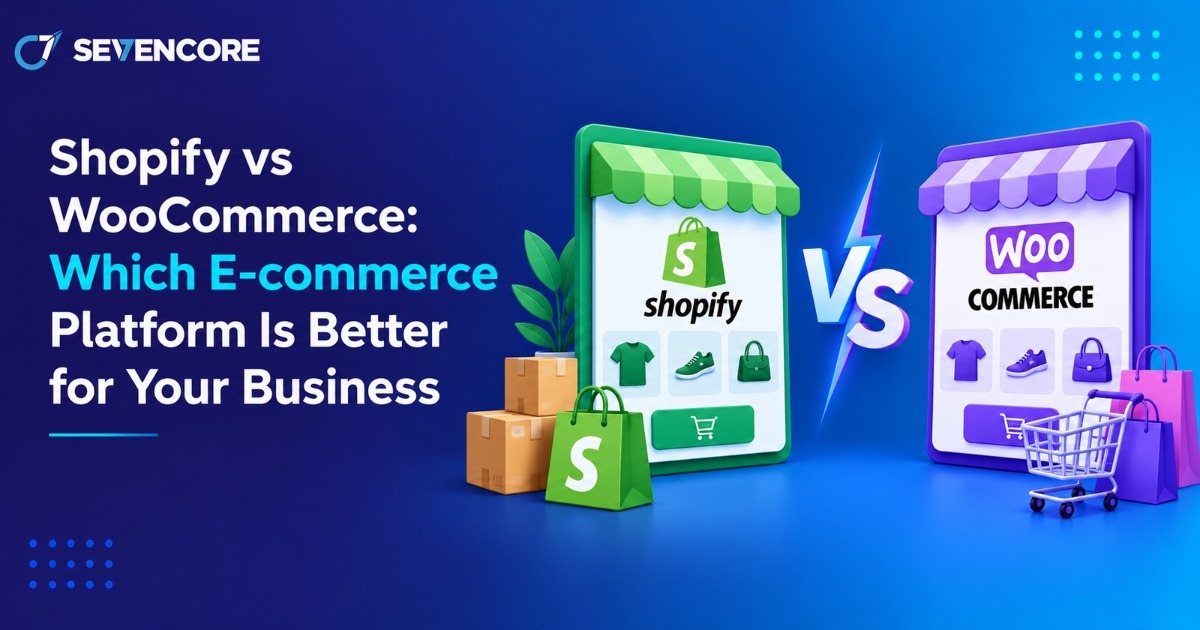
Millions of websites use Shopify and WooCommerce to sell their products online. Shopify is a cloud based, all in one solution, and WooCommerce is a free plugin that converts a website built using WordPress into an ecommerce site.
The platform you use influences many aspects including page speed, shopping experience and scalability of your business. E-commerce platform comparison presented below describes important aspects to compare such as pricing, customization, hosting, SEO and scalability.
Shopify will be the right choice for those who want simple and managed solutions. WooCommerce will be a better option for those who want maximum control or already use WordPress.
What Is Shopify?
Shopify is a hosted ecommerce solution that allows organizations to create and operate their own online store through a monthly subscription.
Main features:
- Hosting and SSL included
- Dashboard for all product, customer, and reporting needs
- Shopify Payments and other payment and checkout providers
- Free and premium templates, along with thousands of apps
- Management of inventory, orders, and fulfillment
What Is WooCommerce?
WooCommerce is an open source, free plugin for WordPress that will help convert your WordPress website into an online shop. It is hosted by you and you have ownership of the code, the data, and everything related to its design.
Main functions:
- Highly customizable templates, fields, and processes
- Management of products and content within WordPress
- Management of products and inventory of both physical, digital, and variation products
- Payment processors such as WooPayments, Stripe, PayPal, and Razorpay
- Plugins for subscriptions, bookings, shipping, and other options
Shopify vs WooCommerce: Detailed Feature Comparison
Here is how the two platforms compare on the seven factors store owners ask about most.
Ease of Use and Store Setup
It is simpler to use. Shopify’s guided onboarding process covers everything from themes to products to payments, all without needing any codes. For WooCommerce, one has to host the website, install WordPress, and configure the plugins. It is easy to use for everyone who knows about WordPress, but people new to it require help from a developer.
Pricing and Overall Development Costs
At the time of writing, the Shopify US plan prices are $39, $105, or $399 per month or $29, $79, and $299 per year respectively. The additional costs of paid apps, premium themes, and 0.6% to 2% charge for using payment gateways are also there. WooCommerce is free, but you need hosting for it, which will cost $25 to $350 per month and paid plugins at $29 to $299 per year each.
Customization and Design Flexibility
Shopify themes can be customized visually, and Shopify store development can customize Liquid codes and applications in Shopify stores. On the other hand, the checkout process and the basic structure are controlled by Shopify. The reason behind this statement is that WooCommerce is an open source solution. Thus, WooCommerce development can customize almost anything, starting from the types of products to the checkout process.
SEO and Content Marketing Capabilities
Editing meta titles and descriptions is possible in both solutions. Shopify will insert canonicals automatically, and all the themes have structured data included, but URLs have fixed prefixes like /products/. As for the blogging tool that WooCommerce uses (WordPress), it offers great opportunities for customization. It also has many useful plugins for technical SEO.
Security and Payment Processing
Features such as SSL, PCI DSS level 1 compliant checkout, fraud analysis, and automatic security updates come with Shopify. Security with WooCommerce relies on you. Typically, the hosts offer SSL while the gateway like Stripe deals with credit card information; however, you need to keep updating WordPress, themes, and plugins.
Performance and Website Speed
The fast speed of Shopify comes from the fact that it uses managed hosting which offers a global CDN, hence reliable speed; however, too many apps and too big themes may make its speed drop significantly. The speed of WooCommerce depends on the quality of your hosting, caching, and images optimization.
Scalability and Business Growth
Both platforms scale automatically based on traffic and orders and allow multiple currencies via Shopify Markets. Shopify Plus is available for $2,300 per month for businesses. Large scale stores can also be created using WooCommerce, but it requires more robust hosting and database optimization with growing order volumes.
Shopify vs WooCommerce: Which Platform Is Better for Different Business Types?
Your choice would depend on how your business operates:
- If you have a startup business or small business, Shopify is easy to launch with; while using WooCommerce would make more sense if you already use a website powered by WordPress.
- Ecommerce stores that are big: They could both work well depending on your infrastructure and planning.
- Content based businesses: The best choice for them would be WooCommerce due to its integration into the WordPress ecosystem.
- Customized functions: This means you can go for WooCommerce.
How to Choose the Right E-commerce Platform for Your Business
Go through the following six questions prior to making any decision:
- Know your business objectives. Is it a test of your products or long term branding?
- Know about your budget. Include everything like development, apps, hosting, and maintenance apart from the subscription.
- Know about your requirements for customization. If it includes a unique checkout or product logic, then go for WooCommerce.
- Check whether the preferred local payment gateways are available.
- Analyze your SEO and marketing strategies. Lots of content marketing would favor WordPress.
- Have a plan for growth.
Conclusion
Shopify is better due to its simplicity, security management and cost predictability. WooCommerce is better due to flexibility, content marketing and complete ownership. Neither is the best online shopping platform out there for each individual firm. You should be looking for something that corresponds to your business type.
Still not sure what suits your needs? Get professional ecommerce development assistance from Sevencore.
FAQs
Is Shopify better than WooCommerce for beginners?
Yes. Shopify needs no hosting setup or coding, and its guided dashboard makes launching a store simple.
Which is cheaper, Shopify or WooCommerce?
WooCommerce has no license fee, so small stores can start cheaper. However, hosting, extensions, and maintenance can bring total costs close to Shopify’s.
Is WooCommerce better for SEO than Shopify?
WooCommerce offers more SEO control through WordPress and plugins. Shopify handles SEO basics well but has a fixed URL structure.
Can WooCommerce handle large e-commerce stores?
Yes, with high-performance hosting, caching, and database optimization. Large catalogs need careful technical planning.
Which platform is more secure, Shopify or WooCommerce?
Shopify is more secure by default because it manages security and PCI compliance for you. WooCommerce can be equally secure when properly maintained.